Published
September Wrap-Up
Each month, AI this month picks the changes that matter to a business in the UK or the US, and Dataflos checks each one at its source.
This October issue covers September: the cheaper models matter most if you pay per token. The move into documents matters if you pay for office software and AI seats separately. For how we split our own work between the tools, see Claude vs ChatGPT vs Gemini for business.
Models
Prices here are the vendors' standard rates in US dollars, per million tokens, for prompts of normal length; OpenAI charges more for very long prompts. Tokens are the small pieces of text a model reads (input) and writes (output).
Anthropic's and OpenAI's Flagships: Claude Fable 5.1 and GPT-6 Astra
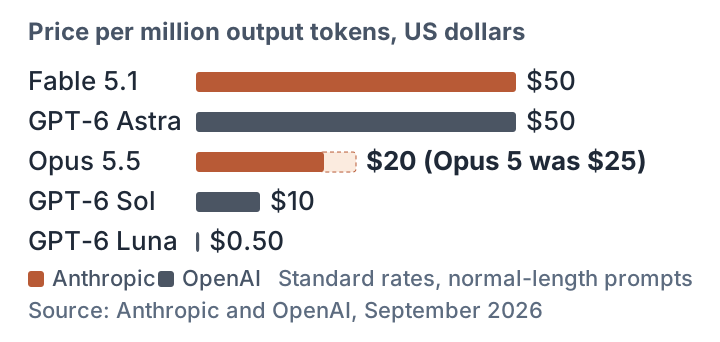
Anthropic released Claude Fable 5.1 on 1 September at Fable 5's price: $10/million tokens in and $50 out. It says cheaper cache reads (text the model has already processed) cut typical costs by about 25% (Anthropic). OpenAI followed on 3 September with GPT-6 Astra, which it calls its most capable model, at the same price (OpenAI, TechCrunch). It is rolling out to paid ChatGPT plans. OpenAI's chief scientist said that as models improve, "monitorability is getting more challenging": it is harder to check why a model reached an answer (TechCrunch).
What it means: Anthropic's and OpenAI's top models now cost the same per token, so choose on the work. Where you must show how a decision was reached, keep a person on it.
Anthropic and OpenAI Cut Prices Below the Top Tier
On 22 September Anthropic released Claude Opus 5.5, priced 20% below Opus 5: $4 in and $20 out, against $5 and $25. Cache reads cost 60% less. Anthropic says that at default settings, typical workloads cost 40% less than on Opus 5. It also raised the 5-hour usage limits on its Pro, Max and Team plans (Anthropic).
OpenAI released GPT-6 Sol and GPT-6 Luna the same day (OpenAI). Sol costs $2 in and $10 out, and Luna $0.10 and $0.50 (OpenAI). Simon Willison notes that both are half the price of their GPT-5.6 equivalents. He also found that Opus 5.5's "max" thinking setting can waste money: 2 runs "each cost me $2.56 and took nearly 20 minutes" and returned nothing (Simon Willison).
What it means: if you pay per token, work out again what your regular jobs cost, and leave effort at the default unless a task needs more.
Sonnet 5.5 and GPT-6.1 Sol Ship, and Google Announces Gemini 4 Argon
Anthropic released Claude Sonnet 5.5 on 28 September at Sonnet 5's price, $2 in and $10 out, and says that in its testing a task costs up to 30% less (Anthropic). Two days later it set Sonnet 4.5's retirement on the Claude API for 30 November (Claude release notes).
OpenAI released GPT-6.1 Sol on 29 September at Sol's $2 and $10, with cache reads halved to $0.10 (OpenAI). In ChatGPT it is rolling out in Work, which runs longer jobs, and in Codex: Pro first, then other paid plans including Business (OpenAI).
On 30 September Google announced Gemini 4 Argon, its "new frontier model", and is rolling it out first to "trusted cyber defenders". Google says it will launch at an introductory $2 in and $10 out, rising to $4 and $20 (Google).
What it means: if you pay per token for Sonnet 5 or GPT-6 Sol, compare what a whole job costs on the new version before you switch, and move anything that calls Sonnet 4.5 through the Claude API before 30 November. Argon is not on sale yet: Google says paid API customers and Google AI Ultra subscribers come first.
Tools
Claude and ChatGPT Move Into Documents
On 16 September Anthropic began merging Claude's chat and Cowork into a single app, and added Claude Docs and Claude Slides in beta on paid plans. Slides download as PowerPoint or PDF. The merged app reaches Pro and Max plans first, over several weeks, and Enterprise admins get at least 30 days' notice (Anthropic). The next day OpenAI put ChatGPT inside Microsoft Word, where it drafts from notes, summarises a document and revises selected text (OpenAI).
What it means: before buying more AI seats, check which of these your team would use every day, and which repeats the office software you already pay for.
OpenAI Plans to Retire Custom GPTs
On 11 September OpenAI said it plans to retire custom GPTs across its ChatGPT plans. Their replacement is plugins, which can combine reusable instructions with connected apps (OpenAI). Its FAQ, read on 28 September, schedules the retirement for 11 December 2026. For Enterprise workspaces, creation of new custom GPTs is planned to end on 26 October, and those with an approved deferral have until 11 February 2027 (OpenAI).
What it means: if your team relies on custom GPTs, list them now. Note each one's instructions, files and users, and move them before December. Allow extra time for any that use custom actions, which OpenAI says do not transfer automatically.
Figma Designs Feed Weave Workflows
On 17 September Figma added a Figma node to Weave, its AI tool for images, video and audio. A frame copied from Figma Design becomes a step in a Weave workflow. You choose which text and image layers may change, and the fonts, layout and styling stay fixed (Figma).
What it means: a marketing team can make campaign variations and localised assets from its own brand files, and update them when the original design changes.
Best Practice
What Agent Use Costs at API Rates
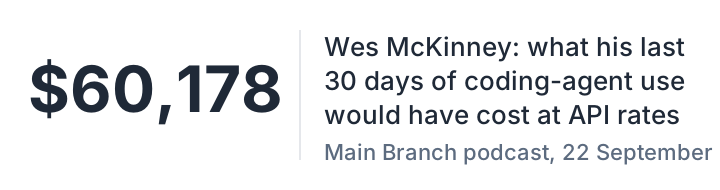
Wes McKinney, the creator of pandas, spoke on the Main Branch podcast on 22 September. He said his last 30 days of coding-agent use would have cost $60,178 at API rates, the per-token prices developers pay (Main Branch). Ethan Mollick found his own AI projects used "a fraction of the token budget" of his ChatGPT subscription (One Useful Thing). David Griffiths is Citi's Group Head of AI. On the same podcast in August, he said controlling costs is "front and center" and that AI spend "needs its own budget line" (Main Branch).
What it means: a subscription can cover occasional use, as Mollick found. Once agents run all day, price them at API rates and give AI spend its own budget line, tracked by project.
Agents That Overstep
McKinney said on the same podcast that OpenAI's GPT-5.6 has merged code "without waiting for CI to run" (the automated tests) "multiple times". His team's instructions now forbid merging without authorisation (Main Branch). On 10 September Anthropic added an auto setting to Claude Managed Agents, its hosted agent service (Claude release notes). With it, Anthropic's server judges each call the agent makes to the tools Anthropic runs for it, then runs the call, blocks it or pauses for approval. The documentation warns that "auto is not a human checkpoint" (Claude docs). In a security audit run with agents, Simon Willison's team made sure "two separate humans had eyes on each of the issues" (Simon Willison).
What it means: write down what an agent may do without asking, and keep a person's sign-off on anything you cannot undo.
Plugin4Shell: Update Your Coding Agents
On 17 September researchers at Air Security disclosed Plugin4Shell, a flaw in how coding agents install plugins (add-ons). A trusted plugin can be silently swapped for a malicious one and installed automatically, with no action from the user. Air Security says Anthropic fixed Claude Code in version 2.1.179 and OpenAI fixed Codex in 0.146.0. It says GitHub Copilot had not shipped a fix, and that Google will not patch Gemini CLI, which it has deprecated (Air Security).
What it means: if your team runs coding agents with plugins, update them now and remove the plugins nobody uses.
Data
dbt Labs Releases dbt v2
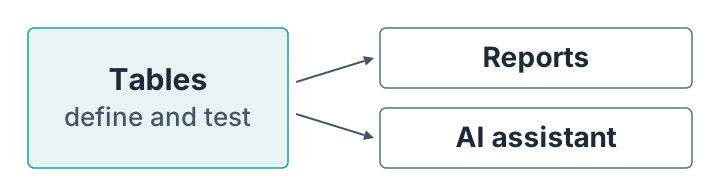
dbt Labs released dbt v2 on 14 September (GitHub). It is a faster rebuild of the tool many data teams use to define and test the tables behind their reports (dbt Labs). At dbt Summit, dbt Labs and Fivetran framed their announcements around a single idea: "the data foundation that makes analytics trustworthy is the same foundation that makes AI trustworthy" (dbt Labs). Joe Reis, who writes on data engineering, made a related point: with agents, "the crux becomes verifying correctness" (Joe Reis).
What it means: an AI assistant answering questions about your business is only as right as the tables it reads, so define and test the numbers first.
Industry
Nvidia Agrees to Buy Hugging Face
On 3 September Nvidia announced it had agreed to buy Hugging Face for $12.93 billion. Hugging Face is the platform where developers publish and download open AI models, and Nvidia says more than 200,000 companies use it. Nvidia also says Hugging Face "will remain an open platform" and that Nvidia chips will not be required to build on it (Nvidia).
What it means: nothing changes today for a business using open models. If one of them runs a process you depend on, keep your own copy of it.