October Wrap-Up
Each month, AI This Month picks the changes that matter to a business in the UK or the US, and Dataflos checks each one at its source.
This November issue covers October: Cheaper models and new spending limits matter if you pay for AI by use. Retirement dates matter if your team or a supplier built tools on older models. For how we split our own work between the tools, see Claude vs ChatGPT vs Gemini for business.
Models
Prices here are the vendors' standard rates for their APIs, the connections developers build tools on, in US dollars per million tokens. Tokens are the small pieces of text a model reads (input) and writes (output).
GPT-6 Becomes ChatGPT's Default Chat Model
On 7 October OpenAI began rolling out GPT-6 as the model behind ChatGPT's Chat tab, and reached the Free and Go plans the next day. Plus and Pro get GPT-6 Sol. So do Business and Enterprise. Free and Go get GPT-6 Luna. Answers can now come "with fully interactive user interfaces", which OpenAI calls Intelligent UI. The models behind ChatGPT's Work and Codex (its modes for longer tasks and for coding) didn't change in this release (OpenAI). On Enterprise, GPT-6 follows the workspace's existing GPT-6 Sol access setting, and admins can turn it off (OpenAI).
What it means: on most plans, your team's ChatGPT answers changed in October without anyone choosing it. Re-run 2 or 3 prompts your team relies on and check the answers still suit how you use them.
Claude Haiku 5.5 and GPT-6.1 Terra Cut the Cost of Routine Work
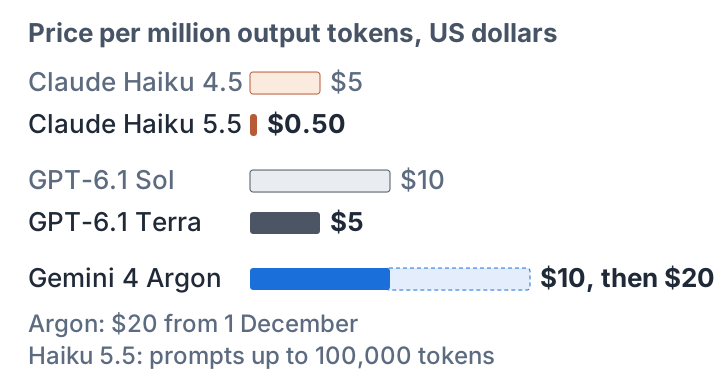
On 7 October Anthropic released Claude Haiku 5.5, its small, fast model, at $0.10 in and $0.50 out for prompts up to 100,000 tokens, and $0.50 and $2.50 above that. Claude Haiku 4.5 costs $1 and $5 (Anthropic). Anthropic says that, counting the extra tokens the new model uses, Haiku 5.5 costs "around 75% less to run" on average. It also halved the price of cache reads (text the model has already processed) on Claude Sonnet 5.5, to $0.10 (Anthropic). Simon Willison measured those extra tokens: about 1.25 times as many as Haiku 4.5 for the same long prompt (Simon Willison).
On 26 October OpenAI released GPT-6.1 Terra at $1 in and $5 out, half the price of GPT-6.1 Sol at $2 and $10 (OpenAI). It began rolling out in ChatGPT's Work and Codex, where OpenAI says a plan's allowance covers "substantially more" tasks than with GPT-6.1 Sol (OpenAI).
What it means: if you pay per token for routine work such as sorting email or reading invoices, run a real batch through the cheaper models and compare what the whole job costs. A new model can use more tokens for the same text.
Gemini 4 Argon Launches, and Its API Price Doubles on 1 December
On 13 October Google released Gemini 4 Argon, announced on 30 September, to paying customers: in its API, in the Gemini app for Google AI Pro and Ultra subscribers, and in Gemini Enterprise (Google, Google, Google Cloud). Its API price is $2 in and $10 out until 30 November, then $4 and $20 from 1 December (Google). Since 26 October, new paid projects on the Gemini API store requests by default. Existing projects keep their setting, and you can switch storage off (Google).
For Google Workspace, Google's admin page lists Argon only under the paid AI Expanded Access add-on, at up to 200 prompts a day (Google). Simon Willison argues that list prices "aren't really comparable these days", since what matters is "how many tokens a model takes to achieve a goal" (Simon Willison).
On 28 October Google announced Gemini 4 Carbon, which it calls its strongest model. For now only a small group of cybersecurity defenders can use it. Google plans to bring it to developers and businesses "as soon as possible", at Argon's introductory price of $2 in and $10 out, then $4 and $20 once that period ends (Google).
What it means: if you build on Argon through the API, budget for the December price now, and expect Carbon to follow the same path. Check whether a new project stores your requests. If you pay for Workspace, check your plan before you expect Argon in the Gemini app at work.
How the Models Compare
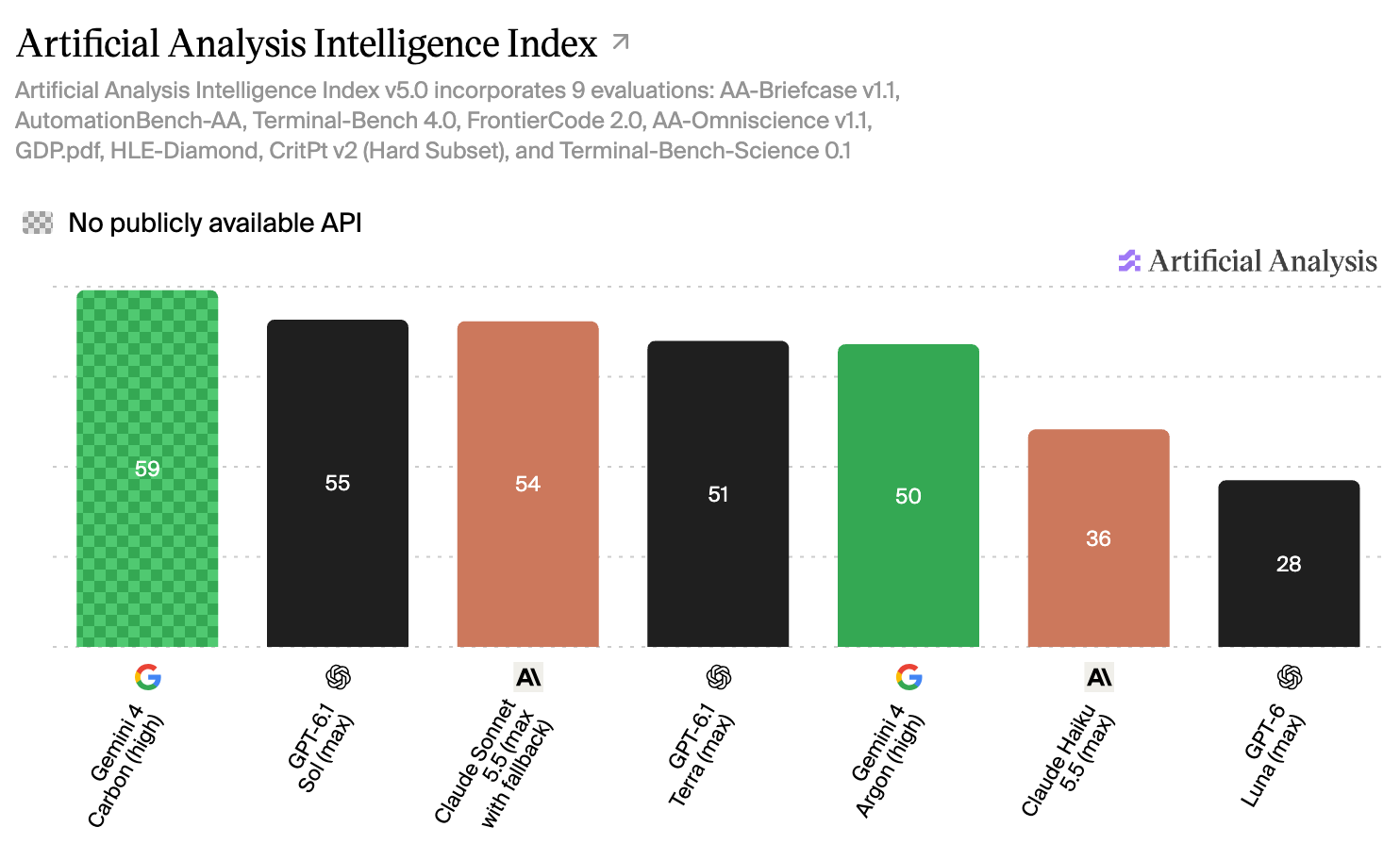
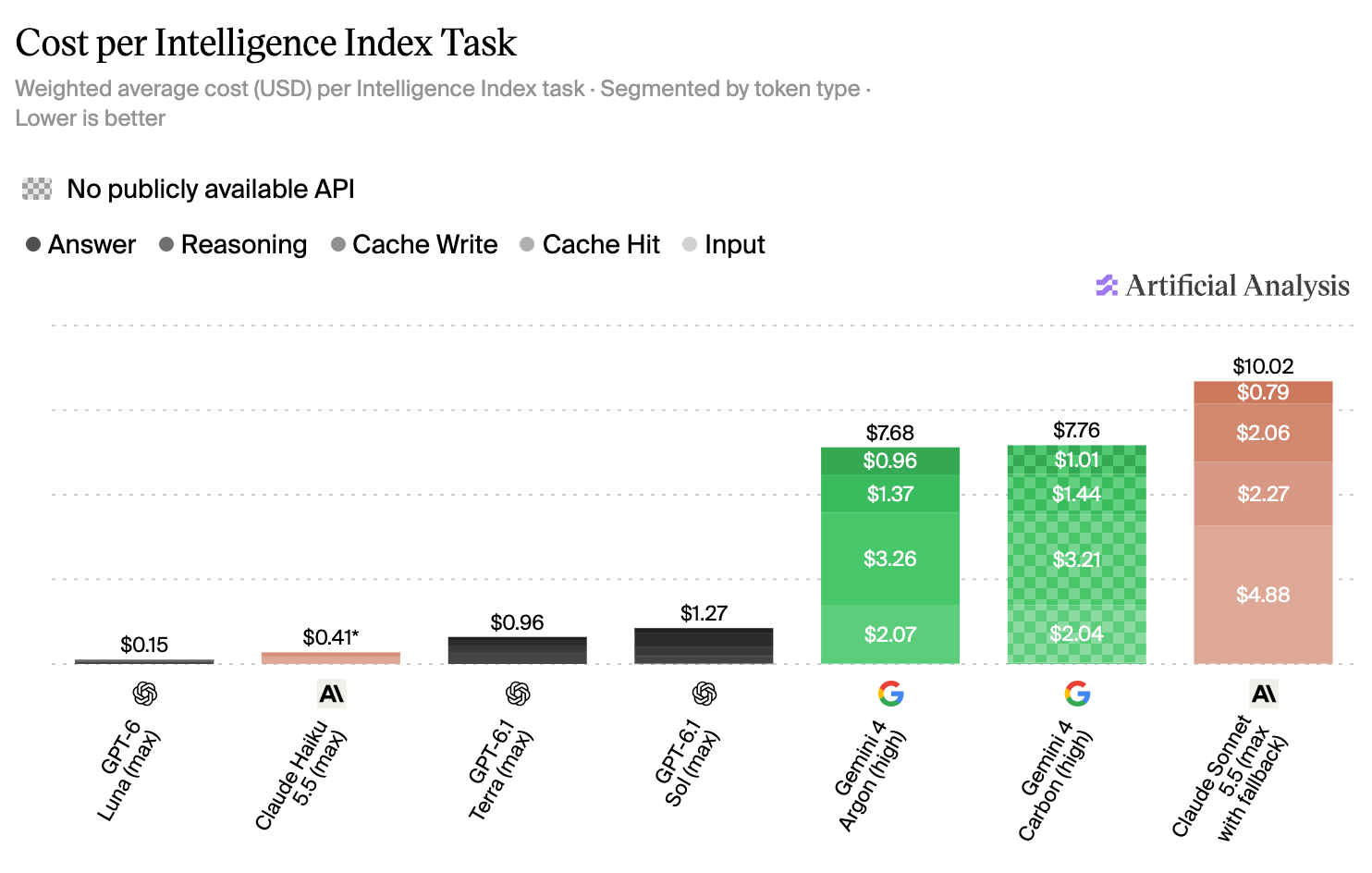
Artificial Analysis, an independent company that tests AI models, publishes the charts below. We chose which of this issue's models to show, as they stood at the end of October. A checked bar means a model has no public API.
Intelligence score
Artificial Analysis combines 9 tests into one score, and higher is better. GPT-6.1 Terra scores 51 to GPT-6.1 Sol's 55, at half Sol's price per token, and Gemini 4 Argon scores 50. Source: Artificial Analysis (artificialanalysis.ai).
Cost per task
This is the average cost of 1 task from those tests, in US dollars, and lower is better. GPT-6.1 Terra costs $0.96 a task and Sol $1.27, so half the price per token saves about a quarter here. Gemini 4 Argon costs $7.68. Artificial Analysis marks Claude Haiku 5.5 with an asterisk because its figure leaves out Haiku's higher price for prompts over 100,000 tokens. Source: Artificial Analysis (artificialanalysis.ai).
A score and a cost per task are a starting point, not a verdict. Before you switch, run a few of your own routine tasks through the 2 or 3 models in your price range, then compare the answers and the bill.
Tools
Claude and ChatGPT Plans Now Include Monthly API Credits
On 7 October Anthropic announced a monthly credit for the Claude API on its Max and Team plans, rolling out that week. Max 5x gets $100 and Max 20x gets $200. Team gets $20 per Standard seat and $100 per Premium seat, pooled across the team up to $500 a month (Anthropic, Claude Help Center). Free, Pro and Enterprise plans aren't eligible, and the credit doesn't cover interactive Claude Code or extra usage in Claude (Claude Help Center).
You claim it by linking a single Console organisation, the developer account that receives the credit. Each organisation can take credit from only one plan, and only support can change the link later. Unused credit expires at the end of each billing cycle (Claude Help Center).
On 28 October OpenAI made a matching offer for ChatGPT. Pro gets $100, $200 or $500 a month, depending on its tier. Business gets $20 per paid Standard seat and $100 per Premium seat, pooled up to $500 a month per workspace. Only Pro and Business qualify, availability varies by country, and the subscription must be at least 7 days old (OpenAI, OpenAI). The person claiming must be an owner of both the subscription and the API organisation. One subscription links to one organisation, each organisation can take only one such link, and changing it means contacting support. The first grant is prorated, Business workspaces that pay yearly get the full year's credit at once, and unused credit expires at the end of each billing cycle (OpenAI).
What it means: if you pay for Claude Team or Max, or ChatGPT Pro or Business, ask an owner to claim the credit and to choose the organisation carefully, since the link is hard to change. Unused credit doesn't roll over.
Custom GPTs Still Retire on 11 December
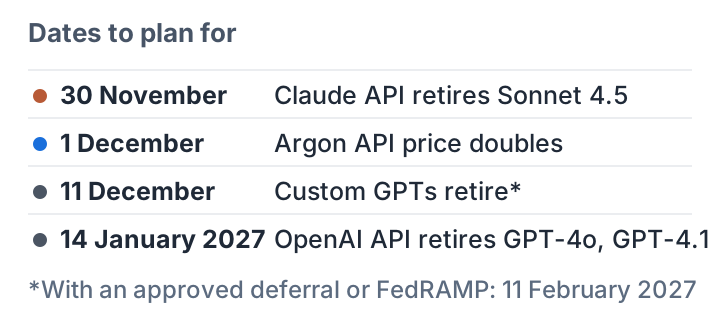
As we reported last month, OpenAI is retiring custom GPTs in favour of plugins. On 26 October it stopped the creation of new custom GPTs in affected Enterprise workspaces, as planned. Existing ones you haven't moved stay usable and editable (OpenAI). Its FAQ, read on 27 October, keeps the retirement date of 11 December 2026, or 11 February 2027 for US government (FedRAMP) workspaces and those with an approved deferral. A GPT becomes read-only once you move it, and migration may open at different times for different accounts. Custom actions still don't transfer (OpenAI). Since 8 October, Enterprise admins can manage plugin access by role (OpenAI).
What it means: if your team relies on custom GPTs, list them with their creators now. Using someone else's GPT doesn't let you move it, though an Enterprise admin can. Finish any edits first, move each one when the option appears, and allow time to rebuild custom actions.
Best Practice
Which Models Do Your AI Tools Run On?
On 23 October OpenAI switched off a batch of older models in its API. They include the original GPT-4, o1 and o3-mini. On 14 October it told developers that GPT-4o and GPT-4.1, with their mini versions, leave its API on 14 January 2027, and named GPT-6 Luna as the replacement (OpenAI). Anthropic retires Claude Sonnet 4.5 from its API on 30 November (Anthropic). A chatbot, an automation or a plugin built 1 or 2 years ago may still call one of these models, and can stop working on the day its model goes.
What it means: ask whoever built your AI tools, in-house or at an agency, which models they call and when those retire, and put the dates in the diary.
Put a Cap on What AI Can Spend
Simon Willison argued on 3 October that services billed by use need hard spending caps, on by default, because agents (AI that carries out a task in steps on its own) make it easy to run up a bill. He expects most businesses "would prefer errors to a surprise $10,000+ bill" (Simon Willison). On 8 October Google Cloud announced spend caps that its new Gemini agent enforces: you set a hard limit on a project's AI spend, Gemini watches token use and sandbox costs, and when spending hits the cap, that project's agent pauses (Google Cloud).
On 23 October Claude Enterprise got the merged Claude app, which puts quick chats and Cowork, where you hand Claude a whole project, in one place. Admins get an Efficient mode that keeps work on the cheaper Sonnet and Haiku models. They can also set spend limits at each level, down to a single member (Claude). Figma's design agent left beta on 6 October and now draws on a plan's AI credits, at a cost that "will vary based on the complexity of your prompt" (Figma). On 22 October Figma started rolling out controls for Enterprise admins to set each person's access to paid AI credits (Figma).
What it means: set a monthly limit on every AI service your team pays for by use, and agree in advance what should happen to work that a limit stops.
Check AI Output With Cheap Decision Models
Decision models are small, cheap models that answer a narrow question, such as yes or no, which suits checking another AI's work. OpenAI took its Decisions API, built for "questions with bounded answers", out of beta on 22 October, at $0.10 per million input tokens with no charge for output (OpenAI).
On 20 October Hamel Husain and Antaripa Saha published a test of 6 such models on 98 logs from an apartment leasing agent, to find the conversations that went wrong. They warn that people use the default threshold, the score at which the model flags an answer, "without checking whether it works well for their task". OpenAI's model scored best, 0.87 on their combined score against 0.79 for the cheapest model that met their bar, at about 4.5 times the cost: 3.72 cents per 100 checks (Hamel Husain).
What it means: if AI answers your customers, ask whoever runs it to score every conversation with a cheap checker and send the flagged ones to a person. Set the cut-off on conversations your team has already judged.
Data
Supabase and DuckDB Adapt Their Tools for AI Agents
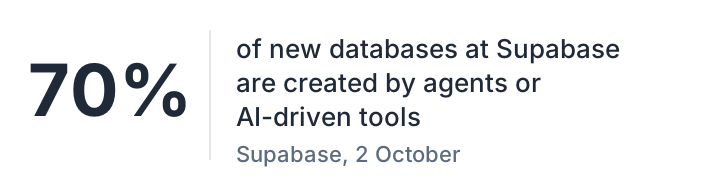
Supabase, a database platform for developers, announced $150 million in new funding on 2 October. It also said it is buying Turso, whose technology can give each agent its own database. Supabase says 70% of its new databases are now "created by agents or AI-driven tools" (Supabase, Supabase).
On 21 October DuckDB, a free, open source analytics database, released version 2.0, supported until at least October 2027. Its command line tool now detects when an agent is running it and switches to a compact output (DuckDB). In DuckDB's own test, an agent read 59% fewer tokens of its output, but that was about 0.5% of everything the agent read, and the saving "did not show up in the total cost or runtime" (DuckDB). Joe Reis, who writes on data engineering, warns that once agents act on data, "stale data matters far more than it did when someone looked at a dashboard once a week" (Joe Reis).
What it means: before you connect an agent to your business data, decide which tables it may read and how fresh each must be, and test those tables first.
Industry
Google Cloud Customers Can Pay for Claude, and Soon OpenAI
On 22 October Anthropic launched Claude Models on Google Cloud (Anthropic managed): Google Cloud customers get Claude on a single Google Cloud invoice, drawn from their existing commitment. Anthropic runs this version and processes the data, and it's available only on US and Global endpoints, with no option to keep requests in the UK or EU. Claude also stays available in Google's own version, where Google processes the data, which Anthropic calls the best choice for "strict regional data residency requirements" (Claude). On 21 October OpenAI said its models and Codex are coming to Google Cloud's catalogue of models, sold through Google Cloud Marketplace and drawn from the same commitments. It planned general availability "in the coming weeks" (OpenAI).
What it means: if your company commits spend to Google Cloud, you can pay for Claude from it now, and for OpenAI once it launches. Check each supplier's terms first. If your data must stay in the UK or EU, Anthropic points to Google's own version of Claude.