
Yes. An agent can draft each client's weekly report from your own data and in your format. It gives the numbers and a short read of what moved. Someone on your team still checks the numbers, the reasons and the recommendations, and nothing reaches the client until they approve it. Here's how Dataflos splits client reporting between the agent and your account lead.
What Our Agent Harnesses Draft Each Week
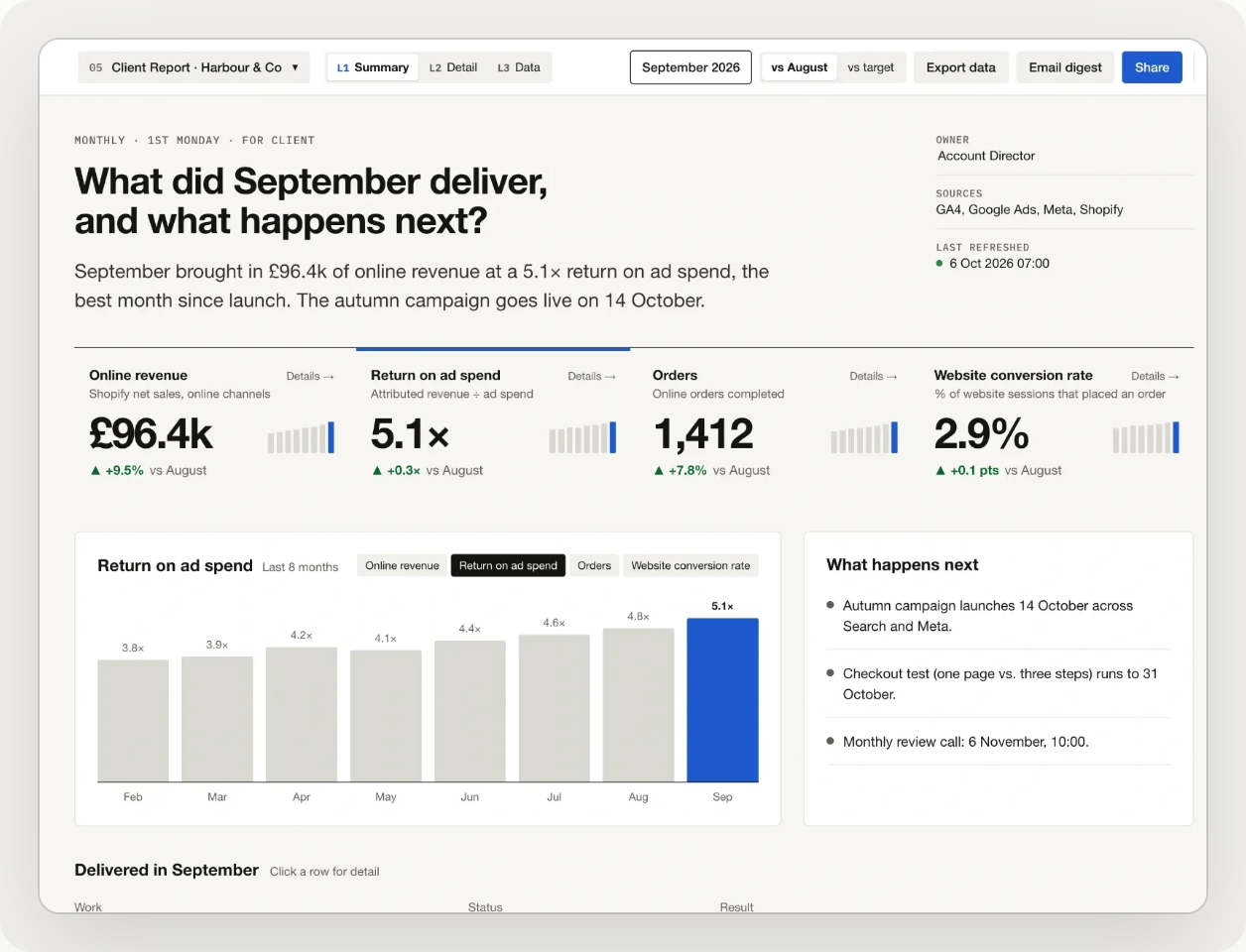
A dataflos Agent drafts each client's weekly report from 1 table of that client's campaign data. It compares this week with the week before and writes 4 sections in your format:
- Headline: the biggest movement this week, in 1 or 2 sentences.
- What's working: the channels and campaigns that improved on last week, with the numbers and the change.
- What slipped: the ones that fell back, with the same detail.
- Recommended actions: 2 to 4 next steps.
Every recommendation has to trace to a movement the report shows. When the data can't explain a change, the agent writes "worth investigating" instead of guessing a cause. It works read-only. It can run queries, but it can't change a figure, and it can't send anything.
Reporting is already a common job for agents — Basis's 2026 survey asked 184 marketing and ad professionals, and of the organisations using agents, 72.3% had them running reporting and analytics.
What Teams Still Checks Before It Goes Out
Account leads typically check 3 things agents can't settle alone: this week's numbers, the reasons behind them and the recommendations.
This week's conversions aren't final yet. Google Ads credits a conversion to the day of the click, so conversions keep arriving for days and land in weeks already reported. Google says this lag can sometimes "cause CPA to look inflated and ROAS to look deflated". Google Analytics says a channel's attributed conversions can still change "for up to 12 days". So the report marks this week's conversion figures as provisional and restates last week as it stands now. Otherwise a week that's 1 day old is compared with one that's 8 days old, and the client sees a drop that isn't there.
The reasons. The table holds spend, clicks and conversions. It doesn't hold the client's sale, a landing page that broke on Tuesday, or a budget cut agreed on Thursday's call. When spend runs as normal and conversions fall to near zero, the agent flags a possible tracking break. Leads knows whether it was one.
The recommendations and the tone. Reports are an agency's voice to the client. In our experience, these are what account leads change most, and tone comes first. There's a bias right now against writing that reads as artificial, so attentive leads put report in their own voice, then bring their own read to the recommendations. Clients ask why anyway, whoever wrote the report, and a recommendation whose reason doesn't follow from the data is the one they question.
Why The Report Reads From One Table
For client reporting, we configure our agents to read 1 defined table per client. Every platform counts conversions its own way, and a model makes fewer mistakes against a schema it has checked.
Take Google's own example. A click on 19 July leads to a purchase on 20 July. Google Ads books the conversion on 19 July, and Google Analytics on 20 July. Google expects the 2 to differ, "often up to 20%". Default windows differ too: 30 days after a click in Google Ads, and 7 days after a click plus 1 day after a view in Meta's API. So the table keeps each platform's numbers on its own basis, side by side, and the report never adds them together.
We saw the schema problem ourselves. We run the data function for an agency with several brands, and every platform's campaign data lands in 1 BigQuery table. The first agent we QA'd ran on a cheaper, faster model. It mismatched a client code's capitalisation, assumed the wrong year and fumbled the SQL. Authors of Spider 2.0, a benchmark built from real-world enterprise databases, reviewed similar errors on 300 sampled tasks. Linking a question to the wrong table or column caused 27.6% of them.
So our agents confirm the schema before any query, and SQL works out the week's dates.
What Goes Wrong, And Rules To Stop Each One
These are the mistakes we've seen or that the research warns about, and the rule we set for each one before reviewers see the draft.
| What goes wrong | The rule that stops it |
|---|---|
| A client code's capitalisation doesn't match, so the client's rows go missing | The agent lists the table's client codes before it filters, and each client has 1 standard code |
| The wrong year, or a week out by a day | Each run is given today's date and the client's time zone; SQL sets the week's start and end, and the report prints its dates first |
| A figure in the text that no query returned | Every number comes from a query result, and the model does no sums of its own |
| This week reads as a fall because conversions are still arriving | This week's conversion figures are marked provisional, and last week is restated |
| Platform totals added together | Each platform reports on its own basis, side by side |
| A tracking break read as performance | Normal spend with conversions near zero is flagged "possible tracking break, worth investigating" |
We've seen the quicker route fail too. Back in April we saw this at at least 2 agencies: platform exports pasted into an AI model, and its answer fitted to a fixed template. One was a client report, the other a quarterly business review. Review caught the errors. Some numbers were wrong, as were names and details only the agency knew. The quarterly review also missed the nuance. So our agents takes every number from a query on 1 table, and leads add the context.
How Approval Works
Every draft waits for a named approver. At an agency running several brands, that's usually a director: strategy, paid media or account. Where an account has an account director and a performance lead, both sign off. The reporting agent never sends a report, never changes a number in your data and never writes to an ad platform.
The draft arrives with its date range at the top and its provisional figures marked. Your account lead checks 2 headline figures against the platform, adds what the data can't hold and edits the recommendations. Then the approver signs it off, and only then does it go to the client. The 4A's offers the same rule for agencies to adopt. Its 2024 policy template for US agencies says team members "will always review, modify and edit any text or images generated by AI" before the work goes to a client. That sign-off makes client reporting safe to hand to an agent.
In our experience, a review takes 30 minutes to an hour and a half, often in gaps of 10 to 15 minutes across a day, with feedback between passes. Client reporting by hand takes about a day per account at one agency we've worked with, and some reports take up to a week at another.
Where To Start With AI Client Reporting
Start with 1 client's weekly report, and run the agent's draft beside the report your team builds by hand for a few weeks before it replaces anything.
Most of the ad industry is still at the trial stage. In June 2026, IAB UK found that 58% of its members are experimenting with or piloting agentic AI. Only 4% call themselves fully agent-first. IAB UK's members include media owners and brands as well as agencies. Basis found that 6.5% of marketing organisations evaluate their AI investments against defined benchmarks. So time the report your team builds today before the agent starts. That's the benchmark the draft has to beat.
If your team wants to ask the data questions as well as read a report, that's a separate step. They ask in the AI they already have seats for, such as ChatGPT or Claude, and the answer comes from the same table.
Frequently Asked Questions
Will our clients know an agent drafted the report?
Tell them, and check your contract. The IPA and ISBA's principles for generative AI ask advertisers and agencies to be open with each other about AI use, though they cover creative work. The 4A's template for US agencies includes a clause saying the agency discloses its AI use to clients. We found no UK or US regulator rule for agency reports, so your contract governs it.
Which platforms can it read?
Whatever lands in the client's table: usually the ad platforms and analytics tools your reports already draw on. We agree the list in the scope.
Does it replace account managers?
No. It drafts the report, and your account lead decides what the client hears.
See Which Client Reports An Agent Can Draft
Get your free AI plan. We'll map which of your client reports an agent can draft first, and what your team keeps.
Get your free AI plan