
When that engineer resigns, the stack goes dark.
Clinical reporting halts. Compliance posture collapses. Executive visibility vanishes overnight.
Data engineer burnout is not a theoretical risk. It is a measured, industry-wide epidemic, and it hits health tech harder than anywhere else.
Solving it requires a departure from conventional hiring — toward modular, fractional data leadership that prioritizes operational continuity and treats raw data as a strategic, protected asset.
For health tech COOs and clinical operations leads, this is the defining operational challenge of the decade.
The Data Burnout Epidemic

The Anatomy of the 97% Collapse: What the data actually says
The numbers describe a collapse, not a slump. In a 2021 survey of 600 data engineers by Wakefield Research, DataKitchen, and data.world, 97% of respondents reported burnout in their day to day roles.
Subsequent industry pulses have not reversed the trend.
Why the role itself drives burnout
Data engineer burnout starts with the role definition itself — or the lack of one.
The job absorbs ad hoc demands from every direction. 91% of data engineers receive analytics requests with unrealistic timelines and quality expectations, and 87% get blamed when data and analytics go wrong, including for upstream entry errors they did not cause.
The modern data engineer must act as a 1 person infrastructure team.
· They extract, transform, and load data.
· They manage the cloud.
· They police data quality.
· They build dashboards on demand for the executive board.
All at once.
The work environment is "whack a mole" by design. Engineers spend most of their hours fixing unexpected errors, patching brittle pipelines, and doing manual data preparation — usually deep into evenings and weekends.
More than two-thirds report frequent disruptions to their work-life balance from unplanned, emergency interventions. 78% say they wish their job came with an on-call therapist.
The 12 month lifecycle
The result is depressingly predictable. A senior data engineer joins. Within months, they drown in maintenance and unrealistic asks.
They burn out. They resign. The stack loses its only owner. Clinical reporting stalls. The firm faces sudden regulatory exposure. Then the cycle restarts.
EMR Interoperability and Clinical Friction

The "Drudge Work" Dilemma: Why health tech burnout hits harder than SaaS
The architecture itself works against the engineer. More than 70% of large healthcare systems still run on outdated platforms, which consume up to 75% of IT budget just to keep the lights on.
That capital traps itself in technical debt instead of clinical innovation.
Legacy EHR and EMR systems were not built for interoperability. They use proprietary formats, inconsistent standards, and very few standardized APIs.
Engineers spend their time building fragile custom interfaces to extract patient data from monolithic systems written in MUMPS or COBOL. Layered on top: regulatory pressure with no slack; HIPAA, SOC 2, and GxP all apply by default. FDA SaMD obligations apply when the software directly informs clinical decisions.
A broken pipeline can harm a patient, breach federal privacy law, or invalidate years of clinical research.
How manual entry corrupts the pipeline
The "drudge work" starts at data entry. In busy clinical settings, trained clinicians, trial coordinators, and medical secretaries spend hours typing into clunky legacy systems.
The administrative burden drives clinician burnout and corrupts the data flowing downstream into the engineering pipelines.
Take REDCap, the trial management system used by 8,000+ institutions across 160+ countries. When data entry depends on manual transcription from paper notes or ambient conversations into REDCap or an EMR, error rates climb fast.
In blood clinics and active trial sites, frontline staff key in patient names, demographics, and biological data by hand.
A misread sample bottle, a mistyped patient ID, or a transposed dosage produces a "bounce" — a turned away patient or invalidated trial data, all from a clerical error.
A browser based fix: ClinicFlos
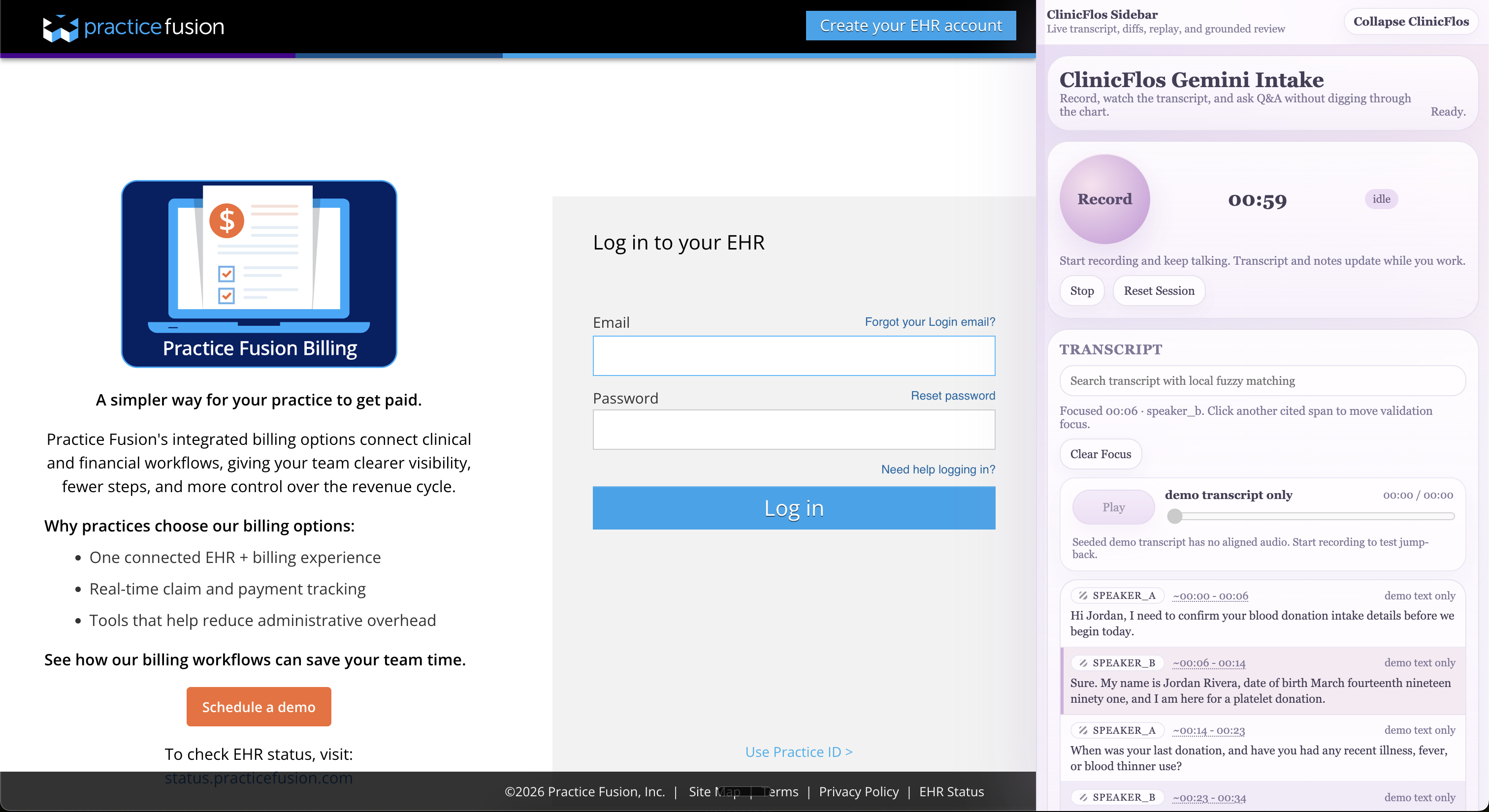
Neutralizing the drudge work means going around the legacy interface, not through it.
Direct API integrations rarely work. Most EMR vendors block or restrict 3rd party access, and they change protocols often enough to make those integrations a permanent maintenance burden.
A more effective approach Dataflos has been exploring uses specialized browser-based Medical Note Taking tools. These tools capture clinical conversations in real time using ambient AI and audio transcription.
Instead of fighting the backend, they operate inside a supported web browser. The tool reads the EMR's HTML state, maps the input fields, and dynamically populates a JSON payload into the EMR's text boxes — no backend permission friction encountered because it doesn't need to ever touch it.
The Strategic Reframe
From "data" to "information" in the boardroom
Solving turnover takes more than clever automation. It takes a top-down shift in organizational psychology.
Data strategy frameworks developed by industry leaders such as UK Head of Data, Pete Hitchens, point at the same root cause: the terminology and accountability structures executive leadership uses about data.
For non-technical CEOs, COOs, and clinical operations leads, "data" has decayed into buzzword noise. It sounds like an isolated IT problem, safely confined to a basement server room.
Reframing it from "data" to "information" cuts through that apathy. The phrase "information is power" lands differently.
"Information" implies strategic value, competitive advantage, and operational risk in a way "data pipelines" never will.
When a COO weighs the risk of "information not being managed properly" — a patient records breach, a HIPAA violation, the loss of clinical trial IP — the criticality of the stack becomes obvious.
Information Ownership in practice
That linguistic shift unlocks the missing element: Information Ownership.
Most healthcare organizations assume the technical data engineering team owns the data. That assumption is operationally disastrous.
When leadership hires an expensive data team, they expect immediate returns. Instead, those engineers spend their tenure as highly compensated digital janitors — undoing the bad data entry, missing governance, and cultural debt of the broader business units.
Information Ownership flips this. The business units that generate the data must take accountability for its purity.
If clinical operations enters incomplete trial metrics, or account management lets patient records go stale, the data engineer should not have to magically clean the warehouse.
Tools like a "traffic light analysis" flag aged or corrupted records. The teams that own the underlying processes then return to the source and rectify the gaps.
The "orchestrator" model
Information Ownership also redefines the technical leader.
Most companies hire one person and expect them to write SQL pipelines, build Python ML models, ship Tableau dashboards, and own ISO 27001 compliance — all at once.
That impossible expectation is a primary driver of data engineer burnout. A successful clinical data leader must instead operate as an "orchestrator of specialist crafts."
They give analysts, engineers, and governance experts air cover so each works inside their narrow expertise.
The Financial Reality: The $1M Cost of Building a Data Team In House

What a real data team actually costs
If you take the orchestrator framing seriously, the defensible alternative is a properly resourced team — not a single overloaded engineer.
For a mid-sized health tech firm, that means roughly 4 roles: a Head of Data, a senior data engineer, a data scientist, and a data analyst.
The math on that team is where most COOs are caught off-guard. Compensation alone for the 4 role team in the US runs $700,000 to $940,000 fully loaded per year.
A senior data engineer base sits between $135,000 and $170,000, with specialists in major hubs above $180,000.
A data scientist runs $130,000–$180,000 base, a data analyst $80,000–$110,000, and a Head of Data $180,000–$250,000. Health insurance, 401K matching, payroll taxes, and benefits add roughly 20 to 30 percent on top of each base.
To compete with FAANG-tier hirers, mid-market health tech firms also offer equity packages — long-term liability on the cap table.
The hidden costs that multiply with each seat
Hiring costs multiply with every additional seat.
The average time to hire a senior technical role has stretched to roughly 95 days in 2026. Specialized recruiters charge 15–30 percent of first-year salary — across 4 hires, that is $80,000–$130,000 in unrecoverable sunk costs alone.
Each new hire then takes 3 - 6 months to ramp up on the legacy EHR architecture. Existing technical leaders lose 20+ hours a week per hire to training during that window.
Combined, the year-one cost of standing up a real in-house data team for a mid-sized health tech firm comfortably reaches $1 million to $1.2 million.
Why $1M is also a compliance risk
That 7 figure outlay also concentrates operational and regulatory risk.
Apply the 97% burnout rate across 4 roles, and the probability of holding all 4 seats for 12 months falls to nearly zero. Every vacancy is also a compliance vacancy. A single point of failure is a single point of compliance failure; 4 points of failure makes that arithmetic far worse.
When any of those 4 departs at the 12 month mark, the institutional context that kept HIPAA controls, SOC 2 audit trails, and data lineage intact walks out with them.
Compliance lapses tend to follow.
In clinical research, high turnover slows workflows, undermines sponsor confidence, and delays multi-million-dollar trials. The team goes partially dark. Reporting halts.
The firm restarts the 95 day hiring cycle for the role that left. For a mid-sized health tech firm, this is not an HR inconvenience — it is an existential threat to cash flow and clinical continuity.
Fractional Alternatives
Modular Continuity and Operational Resilience: Owning the metric, not the tickets
To survive these risks, forward-thinking health tech firms are abandoning the traditional employment model in favor of a fractional data team.
The fractional model delivers a fully managed, embedded data function on a predictable monthly retainer.
It moves the cost of data engineering from a high-risk capital expenditure to a predictable operational expenditure.
The core philosophical distinction is "owning the metric" versus "owning the tickets."
Traditional in-house hires and low-tier implementation agencies focus on completing assigned tickets without understanding the business context. They build pipelines in a vacuum. They ship deliverables. They abdicate responsibility for the outcome.
A premium fractional data team, by contrast, embeds a senior data lead directly into the client's executive team — Slack channels, morning standups, planning sessions.
The fractional lead owns end-to-end delivery, from strategic audit through production-grade orchestration. The data shipped weekly actually moves the metrics that matter to the board.
4 modular pillars: Connect, Insight, Automate, Orchestrate
Dataflos and other firms operating at the leading edge of this model structure their fractional capabilities across 4 modular pillars designed to scale with the client.
Connect
Unified ingestion that pulls fragmented sources — CRMs, legacy ERPs, spreadsheets, APIs — into a single, governed pipeline.
Insight
Decision-ready dashboards, cohort analyses, and AI-assisted insights that establish a single source of truth for the executive board, eliminating the Friday afternoon scramble for accurate numbers.
Automate
Rapid conversion of manual, error-prone data tasks (such as clinical data entry) into autopilot workflows, cutting FTE hours.
Orchestrate
Continuous, production-grade monitoring and governance across all systems for SOC 2, GDPR, and HIPAA compliance by default.
2-3 week deployment
The financial efficiency of the fractional data team shows up clearly in client benchmarks. Repeatable playbooks forged in real enterprise engagements remove the overhead of internal team-building.
Our internal benchmarks across Dataflos engagements indicate fractional data teams routinely deliver senior level output at roughly 4-5x the output/USD of a traditional in-house hire.
Health tech case studies
2 health tech engagements validate the model directly. When PrivateDoc partnered with a fractional team to overhaul their data-growth pipeline, the organization achieved a roughly 40 percent YoY cost saving.
Harri Owen, CMO of Private Doc, noted: "Tools like these end up really providing value so that's brilliant. We're golden."
Flo Health used fractional data leadership to drive rapid digital change and AI-driven creative workflow automation, delivering a roughly 60% YoY cost saving.
Both firms reached enterprise-grade data maturity and continuity without taking on the 7 figure liability or the multiplied burnout risk of building the equivalent team in-house.
A 24 Month Cost Benefit Horizon
In House vs. Fractional
To see the strategic advantage of the fractional model in full, project the financials over a standard 24 month horizon.
The table below combines the line item Year 1 build with the full 24 month total cost of ownership for both options.
| Cost & Risk Category | In-House Data Team (4 Roles) | Fractional Data Team |
|---|---|---|
| Roles required | Head of Data, Sr. Data Engineer, Data Scientist, Data Analyst | Senior data lead + deep specialist bench, all included |
| Compensation, loaded (Year 1) | $700,000 – $940,000 (4 roles, 20–30% loaded) | Included in retainer |
| Recruitment & agency fees | $80,000 – $130,000 (15–25% × 4 hires) | $0 |
| Onboarding & training drag | $80,000 – $120,000 (4 hires × 3–6 mo ramp) | None — established playbooks |
| Software, hardware & licensing | $30,000 – $60,000 (per-seat licenses × 4) | Included in retainer |
| Time to first value delivery | 4 – 9 months per hire (95 days to hire + 3–6 month ramp-up) | 2 – 3 weeks (immediate playbook deployment) |
| Hidden opportunity cost | $100,000+ (delayed clinical trial timelines) | Negligible |
| Year 1 total financial cost | ~$1.0M – $1.2M | ~$204,700 (one-time setup £5,300 + monthly retainer £12,950 × 12) |
| Year 2 total financial cost | ~$850,000 – $950,000 (loaded compensation, assuming zero turnover) | ~$198,000 (£12,950 × 12, predictable OPEX) |
| Employee turnover & burnout risk | Near-certain annual departure (97% burnout × 4 roles) | Zero (continuity guaranteed by deep bench) |
| Replacement cost (per departure) | $150,000+ per role (new agency fees, lost productivity, stalled trials) | $0 (institutional knowledge retained within team) |
| Regulatory & governance posture | Highly vulnerable when any of four roles leaves | SOC 2 / HIPAA-ready by default; continuous orchestrated monitoring |
| Total 24-month estimated TCO | $1.85M – $2.4M+ (assuming at least one replacement cycle) | ~$402,700 (fixed, predictable, efficient) |
(Note: Fractional pricing reflects standard engagement conversions, using a £12,950 monthly retainer and £5,300 setup fee converted to approximate USD figures to allow direct comparison against US salary data. Underlying cost ranges are sourced from the salary, recruiter, ramp-up, and clinical-staffing references linked above and in Further Reading.)
The data is unambiguous: the in-house team model is dramatically more expensive, and it carries an unacceptable level of operational risk.
A mid-sized firm will spend upwards of $1.85 million over 2 years on an in-house team strategy that statistically guarantees catastrophic turnover across multiple roles.
The fractional data team delivers the equivalent capability for roughly one-fifth of the in-house cost. It also neutralizes the risk of the clinical data stack going dark.
Health tech firms get immediate access to a senior data leader, a deep specialist bench, and best-in-class automated tooling — all while maintaining uninterrupted continuity for clinical trials and federal regulatory reporting.
Frequently Asked Questions
How bad is data engineer burnout, really?
The 2021 DataKitchen / Wakefield Research / data.world survey of 600 data engineers found 97% reported burnout, 70% are likely to leave within 12 months, and ~80% have considered leaving the profession entirely. Subsequent industry pulses have not reversed the trend.
Why does burnout hit health tech harder than other industries?
3 reasons: legacy EHR/EMR systems with proprietary formats and few APIs, regulatory pressure (HIPAA, SOC 2, GxP, FDA SaMD) with no slack, and manual clinical data entry that constantly corrupts the downstream pipeline. Engineers spend their time fighting the architecture rather than building it.
What does an in-house data team actually cost?
For a mid-sized health tech firm running four roles (Head of Data, Sr. Data Engineer, Data Scientist, Data Analyst), the year-one cost lands at roughly $1.0M – $1.2M once compensation, recruiter fees, onboarding drag, and per-seat licensing are loaded in. The 24 month TCO with one replacement cycle reaches $1.85M – $2.4M+.
How fast can a fractional data team take over from a departing engineer?
Two to three weeks. Established playbooks deploy directly into the existing stack, bridging the gap without the 95-day hiring cycle and 3–6 month ramp that an in-house replacement would carry.
What is "Information Ownership" and why does it matter?
It's the principle that the business units generating data — clinical operations, account management, trial coordination — are accountable for its purity, not the engineering team. It stops the "garbage in, garbage out" cycle that turns expensive data engineers into highly compensated digital janitors and is one of the largest hidden drivers of burnout.
Securing the Future of Clinical Data
Fragmented legacy infrastructure, uncompromising regulatory pressure, and growing demand for clinical data have made traditional engineering models unsustainable.
The 97% burnout rate is a symptom of a broken corporate system. That system expects solitary technologists to single-handedly solve cultural issues, navigate arcane EMR systems without API access, and absorb the entire burden of compliance.
Health tech organisations, clinical operations leads, and COOs can no longer treat data engineering as an IT byproduct or an entry-level cost center.
The path forward is straightforward. Reframe data as critical "information." Establish firm boundaries of Information Ownership inside business units.
Prioritize structural continuity over single hire bets. Executive leadership reclaims control over the technological future when those three things land together.
Mitigating the 7 figure financial risk of standing up a perpetual in-house team requires structural, modular continuity.
The transition from a single point of failure to a fractional data team ensures specialists — not a single, stressed individual — manage the clinical data pipelines.
Regulatory safety holds. Drudge work gets automated at the source. Decision-ready metrics land on the board's desk every week.
Make your information work sustainably
Book a 30 minute audit to see exactly how Dataflos protects clinical outcomes, secures regulatory compliance, and permanently removes the cost of data engineer burnout from the books.
Book a 30 minute auditFurther Reading
- DataKitchen 2021 Data Engineering Survey — primary source for the 97% burnout figure and related industry statistics.
- 314e Corporation: Legacy Healthcare Systems and Compliance Risks — IT budget and legacy system data for the healthcare sector.
- PMC: Health Information Technology and Clinician Burnout — A Scoping Review — peer-reviewed analysis of how EHR friction drives clinician burnout.
- SCRS: A New Model to Solve Clinical Site Staffing and Retention Challenges — clinical research staffing turnover and operational impact.