The Short Version
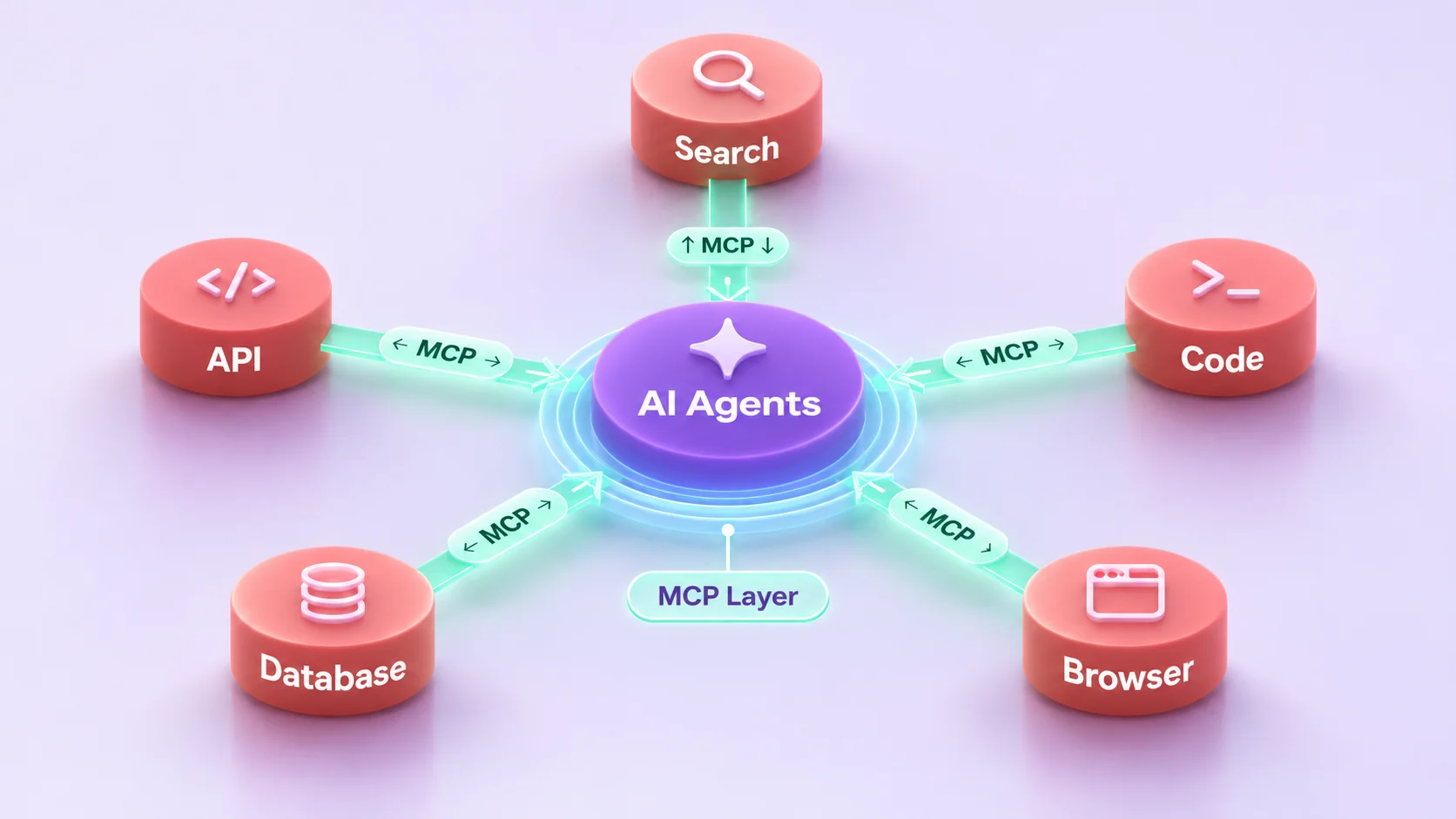
An AI agent is a model that uses tools in a loop, choosing each next step until the job is done. MCP, the Model Context Protocol, is an open standard for plugging those tools and your data into an AI app. Most firms need a fixed workflow, or a built-in connector, before they need to build an MCP server.
Dataflos works with firms of 11+ people: we find the first job worth handing to AI, build it, and keep it running. Your data stays yours.
What An AI Agent Is
An AI agent is a model that works through a task on its own, choosing each next step and using tools until the job is done. A chatbot that only answers questions is not an agent.
The difference that matters is between a workflow and an agent. In a workflow, the steps are written down in advance. In an agent, the model chooses the steps as it goes. Anthropic, which makes Claude, puts it this way: workflows orchestrate "LLMs and tools" through "predefined code paths"; agents "dynamically direct their own processes and tool usage" (Anthropic, "Building effective agents", 19 December 2024). An LLM, or large language model, is the kind of model behind Claude, ChatGPT and Gemini.
The line often blurs. An inbox job that runs every 30 minutes, and only calls a model when something has changed, is a workflow. A research digest can be a workflow with an agent inside: the routine is fixed, but the model chooses its own searches. A Claude Code session is an agent: it decides what to change next, and a person approves what matters. Use an agent only where a fixed process will not do.
A tool is an action the model can request, such as search the inbox or look up a customer. The model asks, and the software around it carries out the request.
What RAG Is
RAG, or retrieval-augmented generation, is a way for an AI model to look things up in your documents before it answers, rather than relying only on what it was trained on. It retrieves relevant passages first, then writes the reply using that material as context (Lewis and colleagues, 22 May 2020; NeurIPS 2020).
RAG finds text to ground an answer. MCP connects an app to tools and live systems. A firm can use RAG with no MCP server, by giving a model a set of files.
What MCP Is
The Model Context Protocol is, in the project's own words, "an open-source standard for connecting AI applications to external systems" (modelcontextprotocol.io, checked 23 November 2026). You describe a tool once, and any app that speaks MCP can use it. Anthropic released it as an open standard in November 2024, and donated it on 9 December 2025 to the Agentic AI Foundation, a Linux Foundation fund co-founded by Anthropic, Block and OpenAI (Anthropic, 9 December 2025).
| Part | What it is |
|---|---|
| Host | The AI app you use, such as Claude or ChatGPT |
| Server | A small program that offers tools or data from one system, such as a CRM |
| Client | The connection the host keeps to each server |
A server can offer actions (tools), information (resources) and ready-made instructions (prompts). The current specification, dated 28 July 2026, is stateless: each request stands on its own, with no session (MCP specification, 28 July 2026).
You ask the AI app a question. The app sends it to the model, with descriptions of the tools its MCP servers offer. If the model needs a tool, the app asks the right server, the server fetches the answer, and the model uses the result to reply or take its next step. An agent goes round that loop as many times as the job needs.
The official introduction names Claude, ChatGPT, Visual Studio Code and Cursor as supporting MCP (checked 23 November 2026). Google documents MCP in Gemini CLI; Microsoft documents it in Visual Studio Code. Claude's connectors directory listed "over 950" MCP servers on 28 July 2026 (Anthropic, "Bringing MCP 2026-07-28 to Claude"). Anthropic's last official total, "more than 10,000 active public MCP servers", dates from 9 December 2025.
Tokens, In Brief
These are AI tokens, not crypto tokens: the pieces a model reads and writes. OpenAI's rule of thumb is that "1 token is approximately 4 characters or 0.75 words for English text" (OpenAI, key concepts, checked 23 November 2026). Anthropic says Claude 4.7 and later models produce "approximately 30 percent more tokens for the same text" (Anthropic pricing, checked 23 November 2026). So 1,000 tokens is about 750 words on OpenAI's rule, and fewer on those Claude models.
You pay per token through the API, with output priced higher than input. Claude Opus 5.5 costs $4 per million tokens in and $20 out (same Anthropic page, 23 November 2026). Chat subscriptions are a flat monthly fee, with a usage limit. Connected tools usually cost tokens too, because most apps send each tool's description with the request. For plan and API costs, see Claude vs ChatGPT vs Gemini.
Do You Need MCP?
Most businesses need MCP later than they think. Stop at the first step that fits.
- Nothing. A one-off question, or information you can paste into the chat. RAG over a pile of documents often lives here.
- A built-in connector. If your AI app already offers a reviewed connector, turn it on and give it the least access that works.
- A no-code automation. If the steps never change and start on a trigger, use a tool such as Zapier or Make.
- A plain API. One system, one app, a steady job, and someone to look after it. If a service already has an API, a developer can give the AI a simple tool that calls it, with no MCP server.
- An MCP server. When the AI has to read or act on your live systems during a conversation, from several AI apps or teams. Use the vendor's own server first, and build your own last.
A red flag at any step: a set-up that combines your private data, outside content such as web pages or inbound email, and a way to send information out. Simon Willison calls this the "lethal trifecta" (simonwillison.net, 16 June 2025). Remove one of the three. Where you can't, have a person approve everything that goes out, and keep each tool's access narrow. If the model itself should not leave your building, see what a local AI server costs.
What Can Go Wrong
- Text can act as instructions. A web page or email that a tool returns can carry hidden instructions to the model (prompt injection). The UK's National Cyber Security Centre says language models "simply do not enforce a security boundary between instructions and data inside a prompt", and that this "may never be totally mitigated" (NCSC).
- A server's own descriptions can mislead. Microsoft's security team warns that changing a tool's description "can redirect the agent's behavior as effectively as a change to its system prompt" (Microsoft Security, 30 June 2026).
- Too much access turns one leak into many. Grant each connector the least it needs. The official MCP registry checks who published a server, not whether its code is safe.
Only connect to servers you trust. OpenAI's ChatGPT documentation, checked 23 November 2026, says write actions "by default require confirmation". Read-only tools can still expose what they read, so we start read-only, limit what each tool can return, and have a person approve anything that sends, posts or deletes. For firms whose data cannot leave their control, see private AI for business.
How We Use Them
- In our coding set-up: we've built MCP servers for our own CRM and for a client's systems. Claude Code connects to those servers.
- In our scheduled jobs: no MCP, by choice. They call each service directly, covering email and calendars, Slack, and Google's documents and analytics. For a fixed routine, a direct call is smaller and easier to test.
- For a client: in June 2026 we shipped a read-only MCP server so an agency team can question their own marketing data from ChatGPT. It reads one table, checks every query against a 1 GB limit, and sits behind the agency's Google Workspace login. Spec to live ran in a single working session.
- Where MCP got in the way: after one model upgrade, jobs meant to use no tools could see our connected tools, used them, and looped until they hit their step limit. The fix was a setting that loads only the tools a job names.
See also how agencies can safely let data answer questions and the Claude, ChatGPT and Gemini comparison.
What To Do Next
If you are deciding whether this belongs in your firm, start with the free AI readiness check. It scores your firm in 2 minutes.