
The model and capabilities your business runs on can be switched off by someone who isn't you. The data, memory, and workflows around it don't have to be. That's the part worth owning.
The Week A Government Switched Off A Frontier Model
On 9 June 2026, Anthropic launched its most capable models to date — Claude Fable 5 and Mythos 5.
3 days later, on 12 June, it suspended both worldwide after the US government applied export controls to the models on national-security grounds. VentureBeat called it "an unprecedented export control directive". The US lifted the controls on 30 June. Anthropic brought Fable 5 back worldwide on 1 July, 19 days after it switched it off. Mythos 5 had returned on 26 June, for a set of US organisations only.
Any product, internal tool, or workflow built on those models had its roadmap changed overnight.
Frontier models are remarkable, and the best are still only available as a rented API. However, it's worth being deliberate about what you let depend on them.
The firms that barely noticed had one thing in common: the model was the only thing they were renting. Everything that made their systems theirs — the data, the accumulated context, the workflows — stayed under their own roof, ready to point at a different model within a day.
For us, the lesson arrived from the other direction. We'd been building with Fable 5 while it was available, and it was a class apart — a jump in quality you don't want to give back. That's exactly what made its removal land. If a tool that good can be switched off overnight — and, for anyone outside the US, switched off by a decision you have no part in — then the capability you depend on shouldn't be one you can lose.

What You Actually Get When You Rent AI
Most modern "AI strategies" rent the whole stack, not just the model. The data goes to a 3rd parties. The memory of every interaction sits on a server somewhere owned by someone else. The integrations, the workflow logic, and the model are all theirs. It can look like ownership; but it's perhaps closer to renting a room in a building.
That holds up until costs, permissions, and service changes occur outside of your control — and they occur more often than most would know:
| Statistic | What it tells you |
|---|---|
| 48% | of organisations admit entering non-public company information into public GenAI tools (Cisco, 2024) |
| 27% | banned GenAI outright over privacy and data-security risk (Cisco, 2024) |
| 11% | of everything employees paste into ChatGPT is confidential data (Cyberhaven, 2023) |

The failure modes are already on the record. Samsung banned GenAI on company devices in 2023 after engineers pasted confidential source code into ChatGPT and couldn't retrieve it. In January 2025, security researchers found DeepSeek had left a database fully open to the public internet — more than a million log lines, including plaintext chat history and API keys. And in August 2025, OpenAI's GPT-5 launch removed GPT-4o with no opt-out; the response forced a reversal within days, with Sam Altman conceding the team "totally screwed up some things on the rollout."
Data Is The Asset. The Model Is A Commodity.
Ownership is a strategy rather than a precaution for one reason: the models are converging, and owned data isn't.
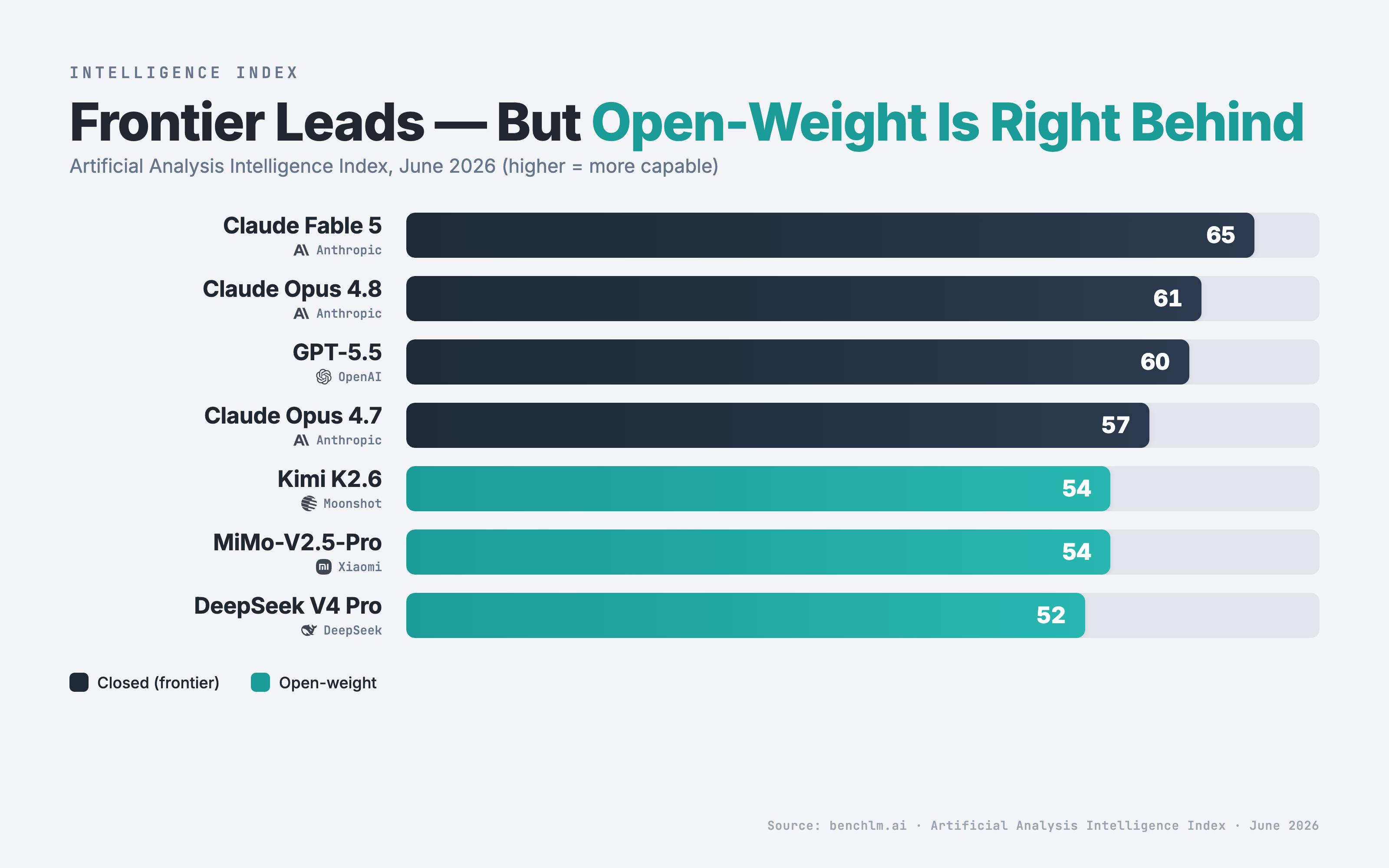
Open weight models have closed most of the gap with the frontier. On individual benchmarks the best are at near-parity; on the broad composite index they now sit within single digits of the frontier — the closest they've ever been (benchlm.ai, June 2026).
Close enough that owning the model — self hosting an open weight one — is now a real option, not a compromise.
Capable models now run on ordinary hardware: OpenAI's open-weight gpt-oss-20b runs in roughly 12GB of RAM on a Mac. Enterprises have noticed — a16z found 81% now run three or more model families in testing or production, hedging against any single provider. The model layer is becoming swappable plumbing.
Your data is the exception. It's the one thing a competitor can't download. Sequoia put it plainly in Generative AI's Act Two: "the next generations of foundation models may very well obliterate any data moats that startups generate. Rather, workflows and user networks seem to be creating more durable sources of competitive advantage." The durable edge isn't the model. It's your proprietary data, the context built up around it, and the workflows that turn both into decisions.
It's also why generic AI tends to underwhelm in practice. As Tiago Forte, who coined the modern "second brain," puts it: "Your AI doesn't really know you. That's the problem." A model with no access to your context returns confident, generic answers. A system grounded in your data returns answers that are actually about your business.
That points to the principle: own everything that lasts — your data, your memory, your workflows — and keep the model swappable, including to one you run yourself. Renting the model is the smart trade today, not a permanent state.
| Rent the whole stack | Rent the model, own the rest |
|---|---|
| Your data lives in a vendor's account | Data stays in your store, under your control |
| Memory and context locked to one product | Memory and context are portable files you keep |
| One model; their roadmap is yours | Model is swappable — point it elsewhere in a day |
| A deprecation or shutdown resets you | A shutdown is an inconvenience, not a reset |
What "Own Your Data" Looks Like In Practice
This isn't abstract for us — we run it. Noema is the internal AI second brain we built at Dataflos. It runs continuously, captures decisions as they happen, drafts replies, prepares meeting briefs, and handles research — all inside the tools the team already uses: Slack, Gmail, Outlook, Calendar, Drive. We built it in about 2-3 weeks in Q2, and have run and optimised it daily since — including a round of improvements just this past weekend, closing gaps and adding new skills. It's built in-house on our own governance, and can be augmented and spec optimised as required.
The point isn't the assistant. It's the architecture, which follows the principle above.
| Layer | What it means |
|---|---|
| Own the data | Every note, decision, draft and project lives in a plain Markdown vault on infrastructure we control — browsable in any editor, version-controlled with git, no proprietary database, no lock-in. The vault is the single source of truth. |
| Own the memory | Search runs on embeddings generated locally — no third-party embedding vendor ever sees the content. The system's recall of past context is a file you keep, not an account you rent. |
| Own the infrastructure | It runs on our own server, not a SaaS vendor's. A four-layer security posture keeps credentials out of the AI's reach, sanitises everything coming in, and blocks any action that would send, post or delete without a human approving it. |
| Rent the model | The reasoning still comes from a frontier model via API, because today that's the best tool for the job. But it's the only rented part. Everything that makes the system ours sits behind a clean boundary, so the model is a setting, not a rebuild. |
That last row is the argument in miniature. When a model is switched off, deprecated, or repriced, Noema loses one interchangeable component — not its memory, its data, or its workflows.
In practice that's a config change. Today Noema runs on Claude Sonnet; moving it to a more capable model is a one-line switch, and self hosting an open weight model on our own server is the next step open to us. The data layer is built to outlive any single model, which is the only safe assumption to make about models in 2026.
Here's how it fits together: your own tools feed a stack you control, and the model is the one rented, swappable part at the end of the line.
- Your dataMarkdown vault — yours
- Local memoryEmbeddings and search — yours
- Control and security layerGuardrails — yours
- The modelFrontier API — rented, swappable
Where Local Models Fit, And Don't Yet
The logical next question: if the data and infrastructure are yours, why not own the model too and self host an open weight one?

For some workloads, you should — and it gets easier each quarter. If you handle regulated or highly sensitive data, or run AI at high volume, self-hosting an open model on your own hardware is increasingly the right call, and the capability gap is now small enough to make it a genuine option rather than a compromise.
But it isn't free.
The point isn't "go fully local." It's that owning your data is what gives you the option. Once your data, memory, and workflows sit behind a clean boundary, where the model runs becomes your decision to make — rented API today, self-hosted open weights tomorrow, a mix after that — on your terms, without rebuilding anything.
If You're Building With AI Right Now
Dataflos builds and runs these systems — for ourselves, and for the teams we partner with. The pattern we see most: capable teams running Gemini and Claude side by side, but with no AI-native foundation to move between them cleanly, and no single place the work lives. The answer usually isn't another tool — it's an operating system you own and plug everything into, so the model underneath stays your choice.
This is mostly a question for founders and senior teams who can see where AI is heading and want to win there, but whose day-to-day teams don't yet have it in scope. The questions worth asking about any AI you're about to depend on are straightforward:
If the answers give you pause, that's the work: own your data, your context, and your workflows — then rent the best model available, and swap it whenever a better one appears, or a worse thing happens.
An edge that runs on someone else's platform can be switched off; one that runs on your own foundation can't. In a market moving this fast, that's the difference between a position you hold and one you borrow. If that's the foundation you want and you'd rather not navigate it alone, it's the work we do — and a conversation is the place to start.