
Over the past year, the large advertising platforms have removed controls that media buyers used to hold, and replaced them with ad automation. Advertisers report that performance is fine. Almost every number supporting that report was published by the company selling the automation.
There's been little investigation or review to compare ad automation against manual campaigns. The largest experiment set that exists was run by a vendor, and it concludes differently.
Current Landscape
Across the ad landscape, two things have changed: Google and Meta. Commentary has run ahead of both.
From September 2026, Google is removing the campaign-level language settings from Search inventory inside Performance Max, and from Search campaigns. Other Performance Max channels keep it. Matching is moving to the language of the creative and landing pages, combined with Google's existing user-language signals. Google simply announces a month, rather than a date, and says advertisers need do nothing.
Meta has removed placement exclusions from ad sets. Value rules replace them, adjusting bids between +1,000% and −90%, so a placement can be made expensive to win, but never blocked outright. Seven Placements are eligible for adjustment. Account-level blocks still exist under Advertising Settings, Account Controls, and Placement Controls. This matters for anyone carrying a brand-safety commitment in a contract. The change has been rolled out in waves since late August, with no announcement from Meta, so it arrives per account, rather than a specified date.
As of writing in September 2026, detailed targeting, demographics, interests, behaviours, location, age and languages are all still at ad-set level. Placements changed. Targeting did not, despite what the write-ups say.
The placement change is an improvement. Building and optimising creative for every placement was tedious and rarely optimised performance.
Nobody Is Complaining About Results
Meta reported Advantage+ end-to-end solutions "reaching over $75 billion in annual revenue run-rate" on their Q2 2026 earnings call. In Meta's Q1 2026 call, more than 8 million advertisers used its generative tools, 2 up from more than 4 million reported in early 2025.
Spend is moving toward ad automation rather than away from it, which is the strongest available signal that buyers are satisfied.
However, satisfaction is not measurement.
An advertiser who sees a platform-reported improvement has evidence that the platform reports an improvement. Proving ad automation caused it, requires a test the platform does not provide.
Who Marked The Homework
| Claim | Published by | Date of the underlying data |
|---|---|---|
| Advantage+ Shopping: 12% lower cost per purchase | Meta | 15 A/B tests, 2022 |
| Performance Max: over 18% more conversions at similar cost per action | Google data, Nov–Dec 2022 | |
| AI Max for Search: typically 14% more conversions at similar CPA/ROAS | 2025, excludes retail | |
| Ranking improvements: 8.3% more ad clicks, 15.7% conversion uplift | Meta | Q2 2026 |
15 A/B tests from 2022, now underwrite a business at a $75bn run-rate. Google's Performance Max claim rests on data gathered in late 2022, and its AI Max benchmark excludes retail. The Meta figures describe a better ranking model: a different claim from an automated campaign beating a manual one. But coverage blurs the two.
The One Large Independent Test Of Ad Automation
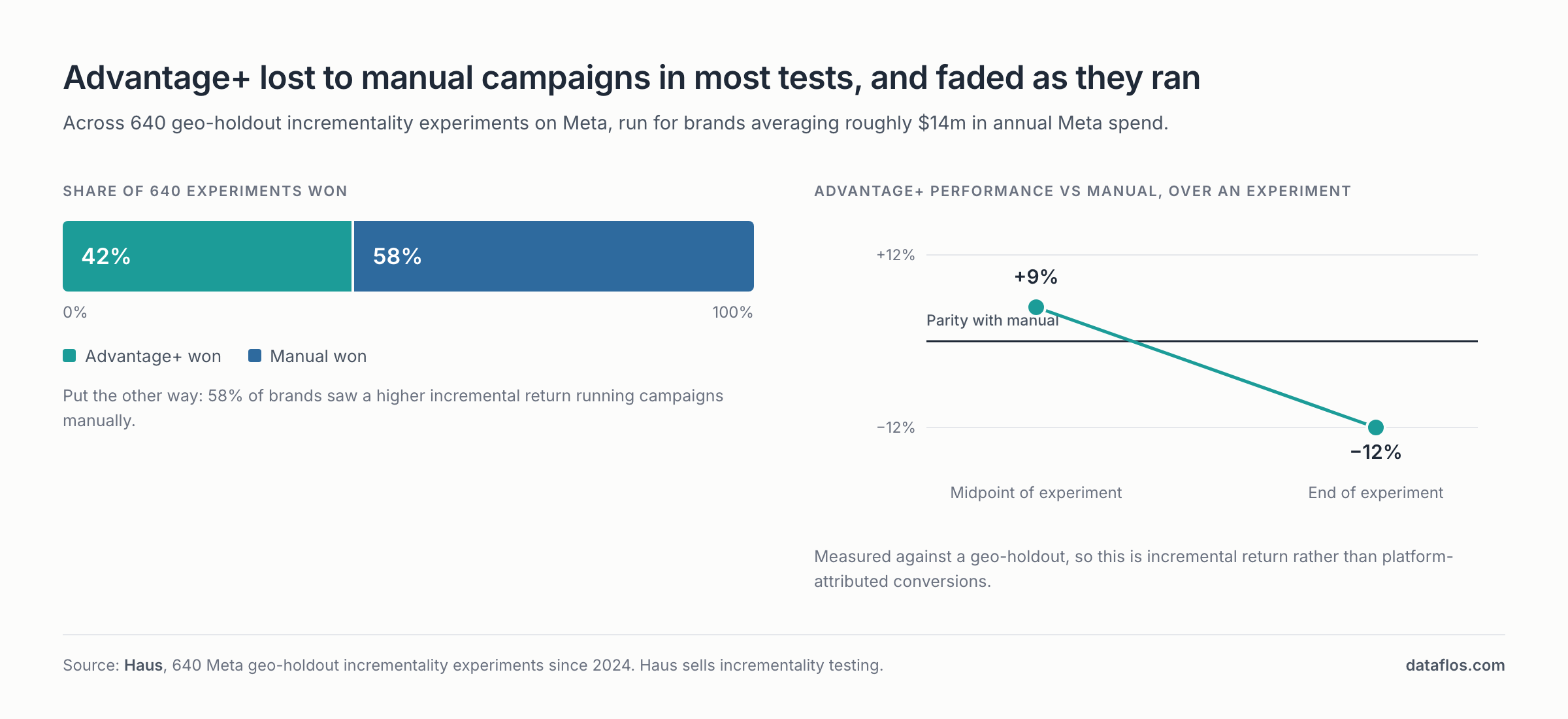
The closest thing to an independent dataset comes from Haus. It has run 640 geo-holdout incrementality experiments on Meta since 2024, across brands averaging roughly $14m in annual Meta spend. Incrementality testing is a vital part of Haus, and it's impartiality is evident.
Advantage+ beat manual campaigns 42% of the time, so 58% of brands saw higher incremental return on manual. The pattern over time is sharper still. Advantage+ ran 9% better than manual at an experiment's midpoint, and 12% worse by the end.
The same dataset cuts the other way on a related point: for every $100 in platform-attributed direct-to-consumer revenue, Haus found Meta actually generated $115 in incremental revenue. Meta, as a channel, under-reports itself. The narrower question, whether the automated product beats the manual one, is the one the evidence answers badly.
Search shows a similar shape. An analysis of more than 250 Search campaigns on AI Max found a median conversion-value lift of 13% alongside a median CPA increase of 16%. Returns ranged from +42% to −35%. The lift corroborates Google's own 14%. Google's "at a similar CPA/ROAS" does not predict the 16%.
What The Platforms Admit
On its Q4 2025 earnings call, Meta said its incremental-attribution feature "is driving a 24% increase in incremental conversions versus our standard attribution model."
So Meta's standard attribution model does not measure incrementality. That model is what most advertisers read as performance.

Custom attribution goes further. Now readily available, custom attribution lets an advertiser pass its own order-level attribution credit back to Meta through the Conversions API as a separate AppendAttribution event. Delivery then optimises toward the advertiser's definition of a conversion instead of Meta's.
That product only makes sense if advertisers' numbers routinely disagree with Meta's. The gap between what a platform reports and what a business believes is now a supported configuration.
On the earnings call of April 2024, Mark Zuckerberg noted that the most quoted statistic in this area is that more than 50% of Instagram content is now AI-recommended. Meta has not restated a share-of-feed figure on any subsequent call, and its Transparency Centre does not publish one. Meta has reported changes since but never a level. A figure from April 2024 is circulating as a description of 2026.
What To Do About Ad Automation
The controls that disappeared were mostly tedium. Per-placement creative production and optimisation absorbed effort and rarely changed a result. On that job, the platforms are probably right that automated matching beats a media buyer with a spreadsheet.
The part that has not been handed over is the measurement.
Run a holdout before you conclude anything — Geo-holdout and incrementality testing produced the only independent dataset in this article. They take 3-5 weeks and enough spend-per-cell to reach significance, which puts them out of reach for smaller accounts. An agency running this for clients needs its own data to answer back. This is what a self-serve layer is for. The question to settle first is whether anyone will act on the answer: if the test proves the case, will the budget actually move?
Keep your own copy of the numbers — When the levers move inside a platform, the reporting layer moves with them. An advertiser whose only record lives inside the platform selling the automation has nothing independent to argue from. The same problem is arriving in AI search, where visibility is measured by the engines doing the answering.
Expect the value question, and answer it with measurement. The anxiety among media buyers right now is about justifying what they are worth when the platform does more of the work. That question cannot be answered with numbers the vendor marked itself. It is answered by knowing what the campaign actually caused. Automated work tends to break at the point a person has to approve or act on it, which is the handoff we have written about before.
Easier platforms still need a specialist. What the specialism consists of has moved, from configuring the campaign to knowing whether it worked.
Twist covers the client conversation in When a client asks if ad automation is working.
Common Questions
Does ad automation perform better than manual campaigns?
Nobody has independently established that. Every positive figure published to date comes from a platform selling the automation. The largest experimental dataset, 640 geo-holdout tests run by Haus, found Advantage+ beat manual campaigns 42% of the time.
Why can't I use the platform's reported conversions?
Platform-attributed conversions record what the platform counts, not what the campaign caused. Meta has said its own incremental-attribution feature drives 24% more incremental conversions than its standard attribution model. That concedes the standard model does not measure incrementality.
Is more than 50% of Instagram content really AI-recommended?
That figure comes from Meta's earnings call of April 2024. Meta has not restated a share-of-feed percentage since, and its Transparency Centre does not publish one. It should not be quoted as a description of 2026.
What should an advertiser do instead?
Run geo-holdout or incrementality tests before drawing conclusions about ad automation, and keep an independent record of performance outside the platform that sells it.
Dataflos makes your data work. That includes the measurement that tells you whether spend caused the result. Trust the data. Don't debate it.